
Meta Behavioral Interview Questions and Answers
If you are preparing for a Meta interview, you have probably spent most of your time grinding LeetCode and brushing up on system design. That makes sense. But here is something most candidates learn too late: the behavioral round at Meta carries just as much weight as your technical rounds, and it is often the tiebreaker between a hire and a rejection.
Meta's behavioral interview is not a casual chat. It is a structured evaluation that measures how well you align with the company's core values. And unlike a coding problem where the answer is either correct or not, behavioral questions require you to tell a compelling story while hitting very specific evaluation criteria.
Let us break down what Meta actually asks, what they are looking for, and how to answer these questions with confidence.
What Meta's Behavioral Interview Actually Evaluates
Meta structures its behavioral interview around a set of core values that the company takes seriously in every hiring decision. These values include moving fast, being bold, building social value, focusing on long-term impact, and being open. Your interviewer is trained to assess how deeply you have lived these values throughout your career.
The interviewer will typically ask five to seven questions in a 45-minute session. Each question targets a specific dimension, and they are listening for real, detailed examples from your work history. Generic answers or hypothetical responses will not cut it.
The Most Common Meta Behavioral Interview Questions
Here are the questions that come up most frequently across Meta interviews, organized by the value they target.
Moving Fast
"Tell me about a time you had to make a decision with incomplete information." "Describe a situation where you shipped something faster than expected. What trade-offs did you make?" "Give me an example of when you cut scope to meet a deadline. How did you decide what to cut?"
Being Bold
"Tell me about a time you took a risk that did not pay off. What did you learn?" "Describe a situation where you challenged the status quo at your company." "When was the last time you tried something completely new in your role?"
Building Social Value
"Tell me about a project where you had to consider the broader impact on users or communities." "Describe how you handled a situation where a feature you were building could have negative consequences."
Focus on Long-Term Impact
"Tell me about a time you sacrificed short-term results for a better long-term outcome." "Describe a project that you are most proud of. Why?"
Being Open
"Give me an example of a time you received tough feedback. How did you respond?" "Tell me about a disagreement with a coworker. How did you resolve it?" "Describe a time when you changed your mind based on someone else's input."
How to Structure Your Answers
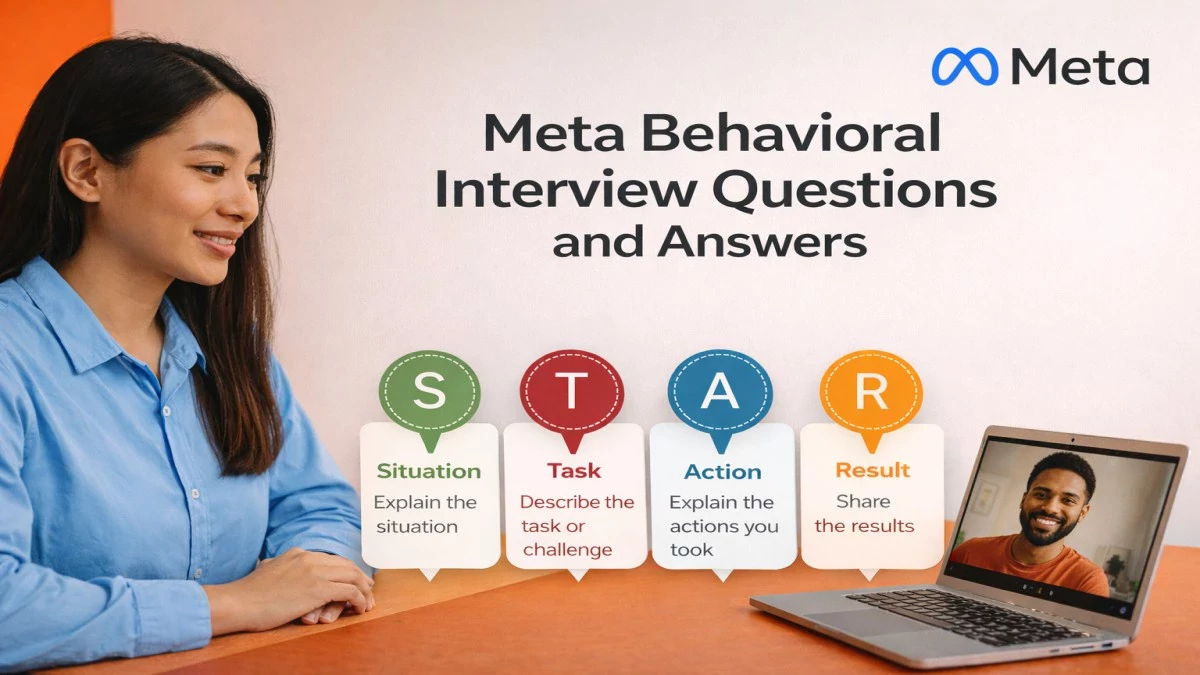
The most effective framework for Meta behavioral interviews is a modified STAR method. STAR stands for Situation, Task, Action, Result. But at Meta, you need to add two more layers: your specific reasoning behind decisions, and what you learned from the experience.
Here is how a strong answer looks in practice:
Start with a concise setup. Give just enough context so the interviewer understands the situation. Do not spend two minutes describing the company and team structure. One to two sentences is enough.
Then explain the challenge or task. What was at stake? Why did it matter? This is where you show judgment.
Next, focus heavily on your actions. This should be the longest part of your answer. Be specific about what you did, not what your team did. Use "I" instead of "we." Explain why you made the choices you made.
Close with measurable results whenever possible. Numbers, percentages, and concrete outcomes are far more convincing than vague statements like "it went well."
Finally, share what you learned or what you would do differently. This is what separates a good answer from a great one at Meta.
Common Mistakes Candidates Make
Being too vague. Saying "I communicated well with stakeholders" tells the interviewer nothing. Instead, explain exactly how you communicated, with whom, and what the result was.
Choosing weak examples. Pick stories that involve real stakes, real conflict, and real outcomes. A story about organizing a team lunch is not going to demonstrate the kind of impact Meta cares about.
Talking about the team instead of yourself. Meta wants to hire you, not your team. Even if you were part of a group effort, focus on your specific contributions and decisions.
Skipping the "why." Meta interviewers are trained to dig into your decision-making process. If you only describe what happened without explaining why you made certain choices, you will get follow-up questions that can throw you off.
Not preparing enough stories. You should have at least eight to ten stories ready that you can adapt to different questions. Each story should highlight a different skill or value.
How to Prepare Effectively
Start by reviewing Meta's core values in detail. Then map each of your prepared stories to one or more of those values. Practice telling each story out loud, keeping it under two minutes. Time yourself.
One of the best ways to sharpen your behavioral interview skills is to practice with someone who has actually been through the process. A mock interview with an experienced interviewer can reveal blind spots that self-practice simply cannot uncover. You will get real-time feedback on your story selection, delivery, and whether you are actually hitting the evaluation criteria.
If you want more structured support, working with a mentor who has experience at Meta can help you build a personalized story bank and refine your delivery over multiple sessions.
What Interviewers Write in Their Feedback
After your interview, the interviewer submits a written scorecard. For behavioral rounds, they rate you on several dimensions and provide specific evidence from your answers. They are looking for concrete examples, not general claims. They note whether you demonstrated ownership, impact, collaboration, and growth mindset.
Knowing this changes how you prepare. Every story you tell should give the interviewer something specific to write down as evidence of your strengths.
Final Thoughts
Meta's behavioral interview is one of the most well-structured in the industry. The good news is that this structure makes it highly predictable and very preparable. The candidates who succeed are not necessarily the ones with the most impressive resumes. They are the ones who can clearly articulate what they did, why they did it, and what they learned.
The best way to prepare would still be with an experienced professional that can give you insights about interviews and actually help you by taking mock interviews. You can find such professionals at BeTopTen! we are comitted to provide top-notch guidance for real world situations.
Put in the work to prepare your stories, practice out loud, and get honest feedback. The behavioral round does not have to be the weak link in your Meta interview loop.
- meta behavioral interview
- behavioral questions meta
- meta interview tips
- STAR method interview
- tech interview preparation
- betopten career guidance