

Engineering Mock Interviews: Improve Real Interview Performance
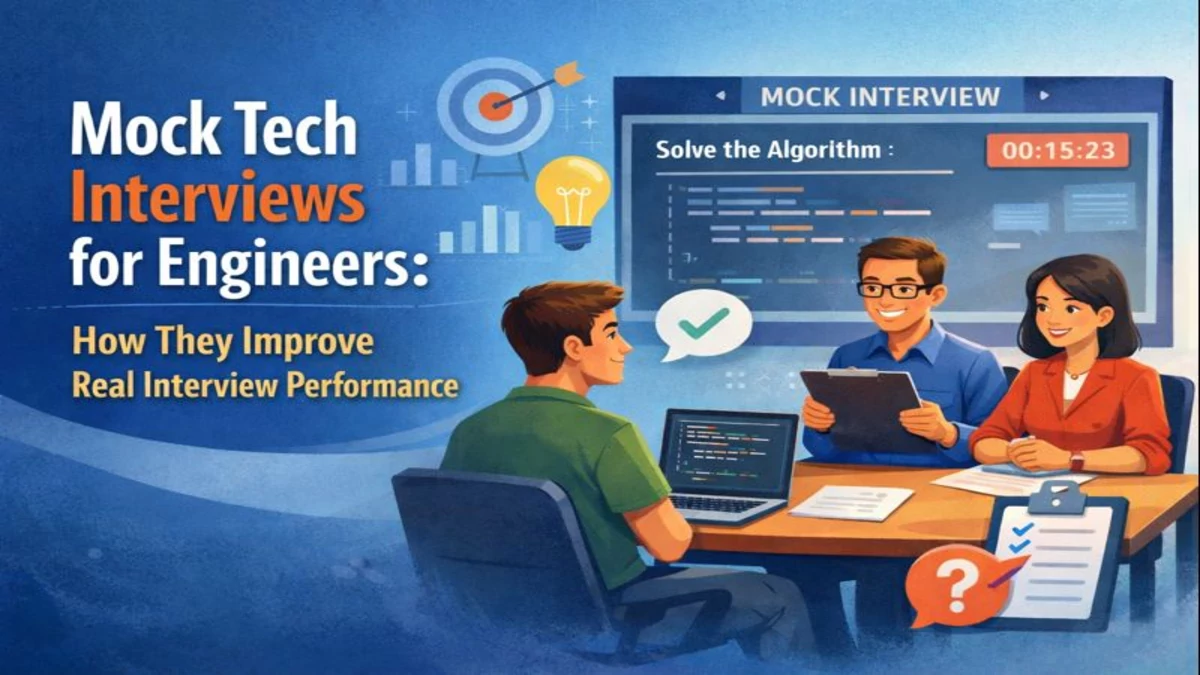
There's a pattern that plays out thousands of times every hiring cycle. An engineer with solid fundamentals, years of real-world experience, and weeks of dedicated prep walks into an interview and underperforms. They know the material. They've solved harder problems at work. But something about the interview environment throws them off.
This is not an edge case. It is the default outcome for engineers who prepare in isolation.
The gap between knowing how to solve a problem and demonstrating that ability live, under time pressure, to a stranger who is evaluating you, is much wider than most people realize. Mock interviews exist specifically to close that gap. Not as a nice-to-have, but as the single most effective lever in interview preparation that most engineers skip entirely.
The Real Reason Strong Engineers Get Rejected
Let's be specific about what goes wrong. It's rarely about not knowing the right algorithm or not understanding distributed systems. The failure modes are more subtle than that.
Engineers solve problems silently. In their day-to-day work, they think through problems in their head, sketch solutions in a notebook, and write code once they have clarity. In an interview, 10 minutes of silence while you think is 10 minutes where the interviewer has no signal. You might be brilliant. You might be stuck. They can't tell the difference, and that ambiguity works against you.
Engineers skip problem framing. At work, requirements come through tickets, PRDs, and conversations with product managers. In an interview, you get a deliberately ambiguous problem. The interviewer wants to see you ask clarifying questions, state assumptions, and define scope before writing a single line of code. Most candidates jump straight to implementation because that's what they do at their desk every day.
Engineers don't articulate trade-offs. When you pick a HashMap over a TreeMap at work, you just do it. Nobody asks you to justify it in real time. In an interview, the ability to say "I'm choosing this approach because of X, and the trade-off is Y" is often the difference between a hire and a no-hire. Interviewers at companies like Google, Meta, and Amazon are explicitly trained to evaluate your reasoning, not just your output.
These are not knowledge problems. They are performance problems. And performance problems require performance practice.
What Actually Happens in Your Brain During an Interview
Interview anxiety is not just "nerves." There's a cognitive load problem that kicks in when you're being evaluated. You're simultaneously trying to solve a technical problem, explain your thinking out loud, manage your time, read the interviewer's reactions, and handle the emotional weight of a career-defining moment.
That's a lot of parallel processing, and most engineers haven't trained for it.
When cognitive load spikes, the first thing that suffers is communication. You start mumbling. You lose the thread of your explanation. You forget to mention the constraint you were optimizing for. The interviewer sees confusion where there's actually competence. It's a frustrating cycle, and the only way to break it is repeated exposure to the same conditions.
This is where mock interviews become irreplaceable. You can't simulate evaluation pressure by talking to yourself in front of a mirror. You need another person, ideally someone who has conducted real interviews and knows exactly what signals they're looking for. Platforms built around career mentorship exist precisely for this reason: connecting professionals with experienced guides who can accelerate growth in ways that self-study simply cannot.
What Good Mock Interview Practice Actually Looks Like
Not all mock interviews are created equal. Doing a casual coding session with a friend is better than nothing, but it's a far cry from what moves the needle.
Effective mock interviews share a few characteristics. First, they mirror real interview conditions: timed, structured, and conducted by someone who understands how hiring decisions are made. Second, the feedback is specific and actionable. "You did well" is useless. "You spent four minutes on implementation before clarifying the input constraints, and that cost you time on the follow-up question" is feedback you can act on.
Third, and this is critical, good mock interviews cover the full spectrum of what's being evaluated. Coding rounds test problem-solving under constraints. System design rounds test your ability to make architectural decisions and communicate them. Behavioral rounds test whether you can articulate impact, navigate conflict, and demonstrate leadership. Each round type requires different skills, and you need practice in all of them.
The best mock interview setups involve engineers or hiring managers who have sat on the other side of the table at top-tier companies. They know the rubrics. They know the common failure patterns. They know the difference between a candidate who is "almost there" and one who is ready. At BeTopTen, the mock interviews are led by mentors from companies like Google, Amazon, and Meta who bring exactly this kind of real-world hiring context to every session.
The Feedback Loop That Solo Prep Can't Replicate
Here's something that surprises a lot of engineers: you don't know what you're doing wrong. Not because you're careless, but because the mistakes that matter most in interviews are invisible to you.
Maybe you have a habit of going quiet for 30 seconds when you're thinking. Maybe your system design explanations jump between layers without giving the interviewer a clear mental model. Maybe you consistently underestimate the time you spend on brute-force solutions before optimizing. These patterns are persistent, they cost you offers, and you will not catch them on your own.
Structured feedback from someone who has evaluated hundreds of candidates breaks this cycle. It turns vague post-interview confusion ("I thought it went well, but I got rejected") into concrete areas for improvement. That clarity is what transforms your next interview from another attempt into a fundamentally different performance.
If you're actively exploring new roles or preparing for an upcoming interview cycle, getting this feedback loop in place before you start applying is one of the highest-leverage moves you can make.
Aligning Your Preparation with How Interviews Are Actually Scored
Most engineers prepare for the interview they imagine, not the interview that actually happens. They assume it's a technical exam where the best solution wins. In practice, hiring committees weigh several dimensions roughly equally.
Problem-solving approach matters as much as the solution itself. Can you decompose a complex problem into manageable pieces? Do you consider multiple approaches before committing? Do you handle hints gracefully?
Communication quality is evaluated throughout. This doesn't mean being polished or charismatic. It means being clear, structured, and responsive. If the interviewer asks "what if the input is very large?" they want you to engage with that constraint, not brush past it.
Adaptability under pressure shows how you'll operate on the job. When your initial approach hits a wall, do you pivot smoothly or freeze? When the interviewer pushes back on your design choice, do you defend it with reasoning or abandon it immediately? These moments carry significant weight.
Mock interviews teach you to recognize these evaluation dimensions and perform well across all of them. Without that awareness, even strong technical preparation leads to uneven interview performances.
From Repeated Interviews to Actual Offers
There is a category of engineer who interviews frequently, gets to final rounds, but rarely converts. They have the skills. They have the experience. Something in the execution keeps falling short.
If this sounds familiar, the issue is almost certainly in the performance layer, not the knowledge layer. More LeetCode won't fix it. Another system design course won't fix it. What fixes it is targeted practice with feedback from people who understand the specific gap between your current performance and what a "strong hire" signal looks like.
This is precisely what mentorship-driven mock interviews are designed for. When you work with someone who has made hiring decisions at top companies, the feedback isn't generic. It's calibrated to the standard you're being measured against.
Making Mock Interviews Part of Your Prep Strategy
If you're preparing for technical interviews, here's a practical framework. Spend the first phase of your preparation building and refreshing technical knowledge: data structures, algorithms, system design patterns, and behavioral stories. This is the foundation. If your fundamentals need work, structured coding problems can help you rebuild that base efficiently before layering interview-specific practice on top.
Then shift to performance practice. Schedule mock interviews regularly, not just once or twice. Treat each session like a real interview. Record the feedback, track patterns, and adjust your approach between sessions.
The engineers who convert interviews into offers are not always the ones with the deepest technical knowledge. They're the ones who have practiced performing under the exact conditions they'll face on interview day. Mock interviews are the most direct path to building that capability.
If you're serious about making your next interview cycle your last, structured mock practice with experienced mentors isn't optional. It's the highest-ROI investment you can make in your career right now.
- Tech Interviews
- Interview Preparation
- Career Growth
- Mock Interviews
- Mentorship
- Software Engineering Careers
- Interview Performance
- BeTopTen